
Non-Combustible Decking Regulations: UK Rules Explained
The 18m and 11m UK thresholds for non-combustible decking and balconies, why composite doesn't qualify, and which materials do.

Author Name
Chief Writer
Thu, 28 Jul 2026
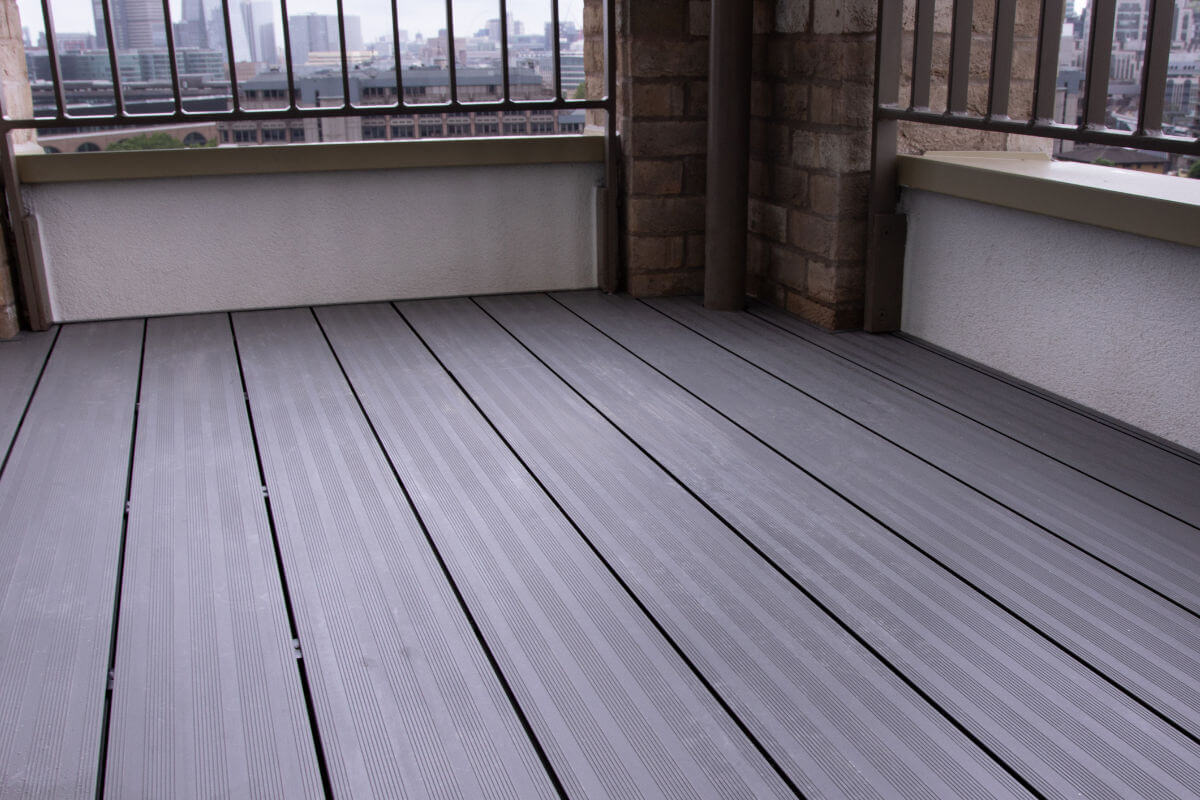
Non-Combustible Decking Regulations: What UK Rules Actually Require
UK building regulations require non-combustible materials in two distinct situations relevant to decking: on the external walls (and attached balconies) of "relevant buildings" with a storey 18 metres or more above ground, and — separately, since December 2022 — on balconies of residential buildings with a storey 11 metres or more above ground. Most wood-plastic composite decking is tested to Euroclass B, C or D and does not meet the required A1 or A2-s1,d0 standard, so it is generally unsuitable for balconies or decking on buildings caught by either threshold. This guide explains what the rules say, where composite decking fits, and what non-combustible alternatives (including aluminium decking) are available.
Disclaimer
This article is general information for homeowners, specifiers and installers, correct to the best of our knowledge at the time of writing. It is not legal, fire engineering or building control advice. Building regulations, fire safety law and their interpretation are complex and building-specific. Always confirm the classification and applicability of any product with a competent fire engineer, building control body, or the manufacturer's technical team before specifying or installing decking on any building covered by these rules.
At a Glance
Threshold
What it Covers
Materials Required
Source
18 metres (storey ≥18m above ground)
External walls and "specified attachments" (e.g. balconies, cladding) of relevant buildings — broadly, buildings containing dwellings, or institutions such as care homes, hospitals and student accommodation, plus (since 2022) hotels, hostels and boarding houses
Class A2-s1,d0 or A1 to BS EN 13501-1
Building Regulations 2010, Regulation 7(2), in force 21 December 2018
11 metres (storey ≥11m above ground)
Balconies specifically, on residential buildings (purpose groups 1 and 2 — e.g. blocks of flats)
Class A2-s1,d0 or A1, OR an alternative fire-resisting soffit and compartment band arrangement
Approved Document B Volume 1, paragraph 10.10 (Volume 2, paragraph 12.11), effective 1 December 2022
Below 11 metres
No general Building Regulations non-combustibility requirement
No mandated Euroclass, though local fire officers, insurers or freeholders may impose their own requirements
N/A — check with building control/fire engineer
Typical wood-plastic composite decking
—
Usually Euroclass D, sometimes C or B — does not meet A2-s1,d0/A1
Manufacturer test data (varies by product)
Aluminium decking
—
Commonly tested to A2-s1,d0 (some mineral/fibre-cement products reach A1)
Manufacturer test data
What does "non-combustible" actually mean under BS EN 13501-1?
BS EN 13501-1 is the British/European standard that classifies how construction products react to fire, using classes A1, A2, B, C, D, E and F, from best to worst performance. Class A1 materials are considered fully non-combustible and do not contribute to a fire at any stage; Class A2 materials have very limited combustibility.
Materials classed A2 or below also receive an "s" (smoke production: s1 best, s3 worst) and "d" (flaming droplets: d0 best, d2 worst) rating — for example, A2-s1,d0 means limited combustibility with minimal smoke and no flaming droplets. In UK regulations, "non-combustible" for construction purposes generally means Class A1, but Class A2-s1,d0 is treated as the practical compliance bar in most of the rules discussed below — the two are usually referenced together as "A2-s1,d0 or A1."
Classes B, C and D are combustible to varying degrees and are not accepted for wall or balcony materials on the relevant buildings covered by the rules below, even though they may be perfectly acceptable, and commonly used, on lower-rise or non-qualifying projects.
What is the 18-metre rule, and does it apply to decking?
Regulation 7(2) of the Building Regulations 2010 (as amended) bans combustible materials in the external walls and “specified attachments” — which includes balconies — of “relevant buildings”: broadly, those with a storey at least 18 metres above ground level containing dwellings, or institutions such as care homes, hospitals, sheltered housing and student accommodation. The ban was extended in 2022 to also cover hotels, hostels and boarding houses.
Materials in scope must achieve Class A2-s1,d0 or A1 to BS EN 13501-1. The rule came into force on 21 December 2018, with limited exemptions for things like window frames, seals, gaskets and similar small components. If a balcony or decked area forms part of the external wall build-up of a relevant building above 18 metres, the decking material itself is caught by this requirement.
What is the separate 11-metre balcony rule?
Since 1 December 2022, Approved Document B Volume 1 (paragraph 10.10) sets an additional, lower threshold specifically for balconies. It applies to residential buildings (purpose groups 1 and 2, which includes blocks of flats) with a storey 11 metres or more above ground — a lower bar than the 18-metre external wall rule.
Under this provision, balconies must either be built entirely from Class A1 or A2-s1,d0 materials, or meet an alternative: a fire-resisting, imperforate soffit (minimum REI 30) covering the full balcony area, plus a non-combustible band at least 300 mm wide at each compartment line. This is a distinct requirement from Regulation 7(2) — it is triggered at a lower height and applies specifically to balcony construction rather than the external wall generally, so the two should not be conflated when assessing a project.
Why doesn't composite decking usually qualify?
Wood-plastic composite (WPC) decking is manufactured from a blend of wood fibre and plastic (typically polyethylene or polypropylene), both of which are combustible. Independent test data shows most composite boards achieve Euroclass D, with some formulations reaching C or, less commonly, B — none of which meet the A2-s1,d0 or A1 bar required at the 11m and 18m thresholds described above.
This means composite decking, including EnviroBuild's own composite ranges, is not suitable for balconies or decking on relevant buildings above these thresholds, regardless of any general fire-retardant additives a manufacturer may include. Below these thresholds, composite decking remains a widely used and code-compliant choice for houses, gardens and lower-rise projects — the restriction is specific to the height and building-type triggers above, not a blanket judgement on the product.
What non-combustible alternatives exist?
Where a project falls under the 11m or 18m rules, specifiers need a decking material independently tested to A2-s1,d0 or A1. The main categories are:
Aluminium decking
— extruded aluminium board systems are commonly tested to Euroclass A2-s1,d0, and some mineral-coated or composite aluminium systems reach A1. EnviroBuild supplies aluminium decking (including a balcony-specific range) tested to A2-s1,d0 as a non-combustible option for these applications.
Mineral and fibre-cement decking
— fibre-cement or mineral-based boards can achieve A1 or A2-s1,d0 fl (the “fl” suffix denotes flooring-specific test method), making them another route to compliance.
Stone or porcelain paving
— natural stone and porcelain/ceramic tiles are generally non-combustible (A1) and are sometimes used on qualifying balconies, subject to structural loading and slip-resistance checks.
Any product claim should be checked against the manufacturer's actual test report (not just marketing copy), since classification depends on the specific tested build-up, fixings and substrate — not the raw material alone.
How do I check if my project falls under these rules?
Start by establishing the height of the highest occupied storey above ground level, not the overall building height — this is the trigger point used in both the 18m and 11m rules, and measurement conventions matter (roof-top plant rooms are typically excluded, for example). Next, identify the building's use: the 18m rule applies to relevant buildings (dwellings and specified institutions, plus hotels/hostels/boarding houses since 2022), while the 11m balcony rule applies specifically to residential purpose groups.
Because the rules are height- and use-specific, and measurement and classification details can be technical, it's sensible to confirm applicability with your building control body or a fire engineer before finalising a decking specification — particularly for conversions, mixed-use buildings, or projects near a threshold.
FAQ
Is composite decking banned on all balconies?
No. It is restricted on balconies of residential buildings with a storey 11 metres or more above ground, and on relevant buildings above 18 metres — not on balconies or decking generally. Below those thresholds, composite decking remains a common, compliant choice, subject to any project-specific requirements from building control, insurers or freeholders.
What's the difference between A1 and A2-s1,d0?
A1 means a material is fully non-combustible and does not contribute to fire at any stage. A2-s1,d0 means very limited combustibility, with minimal smoke and no flaming droplets. UK regulations generally accept either classification as meeting the "non-combustible" bar for the rules covered here.
Does the 18-metre rule apply to my house?
Almost certainly not — it applies to buildings with a storey at least 18 metres above ground that are relevant buildings (dwellings/blocks of flats, specified institutions, or hotels/hostels/boarding houses). Most houses and low-rise extensions fall well outside this scope.
Can I use standard composite decking on a low-rise balcony?
Possibly, if the building doesn't meet the 11m or 18m thresholds and no other restriction applies (for example, from a freeholder, insurer or local fire officer). Always check the specific building's height and status before assuming a product is suitable.
Is aluminium decking guaranteed to meet A2-s1,d0?
Not automatically — classification depends on the specific tested product and build-up, not just the base material. Always request the manufacturer's BS EN 13501-1 test certificate for the exact product and configuration being specified.
Who decides if a building is a "relevant building" for these rules?
This is a judgement based on height, use and construction, generally confirmed with your building control body (or, for Higher-Risk Buildings, the Building Safety Regulator). If in doubt, seek advice before specifying materials.
Further Reading
Sources
legislation.gov.uk — The Building Regulations 2010, Regulation 7 (materials and workmanship, including the combustible materials ban)
legislation.gov.uk — The Building (Amendment) Regulations 2018 (SI 2018/1230), introducing Regulation 7(2)
legislation.gov.uk — The Building etc. (Amendment) (England) Regulations 2022 (SI 2022/603) — Explanatory Note
gov.uk / Approved Document B, Volume 1: Dwellings (2019 edition, incorporating 2020 and 2022 amendments) — paragraph 10.10, balcony requirements
BSI — BS EN 13501-1: Fire classification of construction products and building elements
RICS Built Environment Journal — How Part B changes complicate balcony design
Cundall — Amendment to the Approved Document B and Building Regulations, June 2022
This article does not constitute legal or fire engineering advice. See the disclaimer above.