
100% Recycled Plastic Decking Installation: Step-by-Step Guide
Built from entirely recycled plastic waste, 100% recycled plastic decking offers unmatched longevity, sustainability and resistance to the elements. It’s ideal for areas exposed to moisture or constant wear, such as walkways, marinas and nature trails, where traditional timber or composite decking might degrade over time.

Author Name
Chief Writer
Thu, 28 Jul 2026
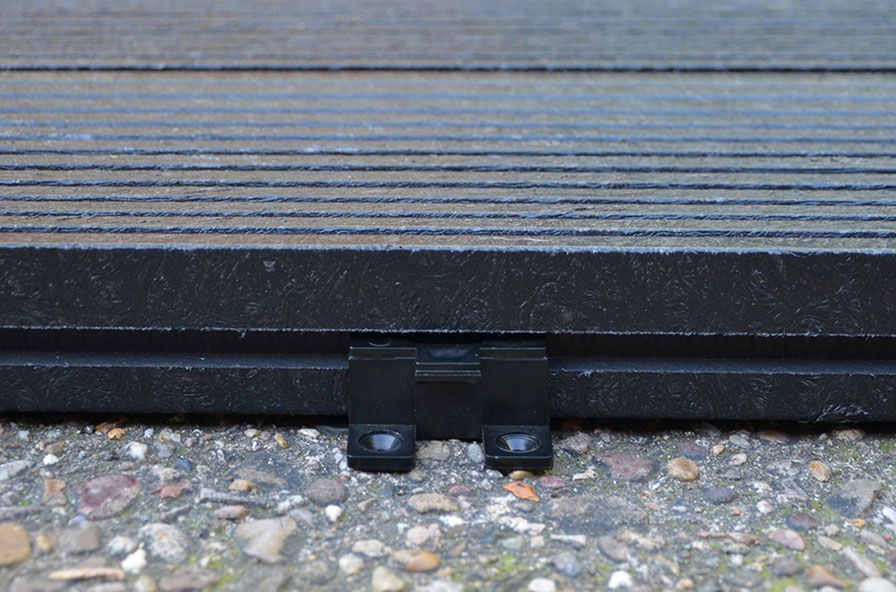
This step-by-step guide explains how to install recycled plastic decking to ensure a long-lasting surface that performs in even the harshest conditions.
Why Choose 100% Recycled Plastic Decking?
Recycled plastic decking is engineered to last for decades without rotting, splitting or absorbing water.
Key advantages include:
100% recycled: Manufactured entirely from post-consumer plastic waste.
Extremely durable: Resistant to rot, algae, insects and moisture.
Low maintenance: No painting, sealing or staining required.
Because of its density and rigidity, recycled plastic decking is heavier than timber or composite boards, meaning proper support and fixings are crucial for a stable installation.
Recommended Tools
Standard woodworking tools can be used when working with Manticore® Decking. If you are unsure on how to use any tools, please consult the tool manufacturer’s user manual.
Safety Glasses and relevant Personal Protection Equipment
(PPE).
Circular Saw; we recommend a tungsten carbide blade to
ensure the best finish (small metal fragments can get through
the recycling process).
Tape Measure
Hand Drill: 3 mm and countersink drill bits (can use an all-in-one
smart bit).
Impact Driver; use T15 secure drill bit supplied in all Manticore®
hidden fastening packs and use low technique setting.
Carpentry Square
Spirit Level
Chalk Line
Stainless steel chipboard screws with countersunk heads are
recommended, use V2A, 4.5 x 60 mm for the screw connection
to the substructure.
Material Handling
Manticore® Decking materials should be placed with care when
unloading.
When removing boards from a unit, lift the boards and set
them down. Do not slide boards against each other when
moving them.
Carry Manticore® Decking boards on the edges for better
support.
During construction, do not slide or drag any equipment across
the boards.
The surface of the boards should be kept free of construction
material and waste to prevent damage.
Each 3.1 m decking board can weigh over 20 kg, so please
ensure they are handled safely. We recommend that two
people handle the boards during transportation.
Material Storage
Materials should always be covered until ready to be installed
in order to maintain a clean surface.
All products should be stored flat and level, supported above
the ground at 500 mm intervals.
Battens used to separate and support stored material should
be spaced no more than 500 mm apart, to ensure the boards
don’t bow.
Stack units with banding and bottom supports aligned.
Pallets of decking boards should not be stacked more than 4
pallets (3 m) in height.
Installing the Subframe
Manticore® Decking can be installed on various sub-frame choices; treated timber or plastic lumber anti-rot joists. For all types of sub-frames you must adhere to the following rules:
The joists are designed to take live loads, any static loads must
be placed over the supports.
Only use tungsten carbide tipped drill bits and saw blades for
working with plastic lumber, we do not recommend diamond
tipped blades (small metal fragments can get through the
recycling process).
To allow sufficient drainage, a drainage slope of 0.5% (5 mm
per meter) should be incorporated.
Due to temperature induced expansion and contraction
with plastic lumber, you should never fix bearers directly to
foundations; if you have to fix the bearers to the foundations,
use expansion clips.
Plastic bearers should be installed with the greatest dimension
as the upright.
The bearer must not overhang a support by more than 50 mm.
Where lumber meets a cross beam, you must leave a minimum gap of 10 mm from the bearer end to the cross beam. These can be joined using expansion L-brackets over a support or with joist hangers.
A joist must be used under deck board ends, and a double joist structure must be used to support deck butt joints.
Spacing the Boards & Subframe
Due to natural expansion and contraction of material with changes in temperature, please ensure the following gapping requirements for all Manticore® Decking products:
Manticore® Decking board side-to-side gaps should be a minimum of 5 mm.
Manticore® Decking board butt joint gaps should be a minimum of 8 mm.
Manticore® Plastic Lumber joist butt joint gaps should be a minimum of 20 mm.
When abutting to walls or other fixed objects, a minimum gap of 20 mm is required.
Manticore® Decking boards should not overhang joists by more than 20 mm.
To ensure sufficient water run-off, a drainage slope of 0.5% (5 mm per meter) should be incorporated.
How to Install 100% Recycled Plastic Decking
With your sub frame levelled and stable, you can now start installing your deck boards.
Clamp the board to the subframe and drill pilot holes through the boards into the substructure.
Each board should placed perpendicular to the orientation of the substructure.
Pilot holes should be lined up with joist centres.
Drill two pilot holes for each board and joist.
The pilot hole should go through both the decking and a little way into the joists.
To fix the boards to the substructure, insert a screw into each pilot hole previously made.
The boards should be 5 mm apart.
Screw in until the screw sits flush with the surface of the
decking.
Inspection and Maintenance
Once installation is complete:
Check that all fixings are secure and flush.
Confirm that the deck surface is level and free from movement.
Sweep away dust and rinse with water.
Ongoing maintenance:
Clean occasionally with mild detergent and water.
Avoid harsh solvents or pressure washers.
Re-tighten screws periodically if needed.
Recycled plastic decking requires no sealing, staining or painting, its non-porous surface naturally resists mould, algae and fading.
Common Mistakes to Avoid
Over-tightening screws.
Skipping expansion gaps.
Using incompatible fixings (e.g. standard steel screws that rust).
Installing on uneven or unstable ground.
Neglecting drainage slope, causing standing water.
Avoiding these ensures your recycled plastic decking remains stable and built to last.
Explore 100% Recycled Plastic Decking and Substructure Systems
Installing 100% recycled plastic decking delivers unmatched durability, sustainability and performance. With proper planning, spacing and fixings, it provides a zero-maintenance, weather-resistant surface that stands the test of time, all while giving waste plastics a new life.
Perfect for high-wear, wet or remote locations, this decking solution offers eco-friendly longevity that outperforms timber and composite alternatives for decades.
EnviroBuild offers a complete range of 100% recycled plastic decking boards, joists and accessories, engineered for low-maintenance installations and long-term strength.