

At a Glance: Composite Decking Problems Covered
Fading: UV breakdown of surface pigments and polymer
Mould, algae and mildew: organic debris trapped in surface moisture, not growth inside the board
Gapping, buckling and warping:
thermal expansion/contraction without adequate spacing
Staining: tannins, rust and oils bonding to the surface layer
Scratches and surface wear: abrasion of the cap layer or uncapped face
Loose boards: fastener, clip or subframe movement
Subframe rot: moisture trapped against timber joists
Slipperiness and water pooling: biofilm build-up and inadequate drainage fall
Composite (wood-plastic composite, or WPC) decking is made from recycled wood fibre bound in a recycled plastic matrix, sometimes finished with a co-extruded “cap” layer for extra protection. Understanding why each fault happens — not just how to wipe it away — makes it much easier to prevent.
Why Does Composite Decking Fade in the Sun?
The cause:
Fading is predominantly caused by the washing out of natural wood oils ‘tannins’ from the wood fibers within the board material. Then over time photo-oxidation occurs where UV radiation carries enough energy to break chemical bonds in surface pigments and polymer chains, gradually shifting colour and dulling the surface. Uncapped boards weather fastest because they don’t have an outer protective layer to prevent the tannins from being washed out, also capped boards use a co-extruded “capstock” layer loaded with UV inhibitors and pigments specifically to absorb that energy before it reaches the core. See our full guide on whether composite decking fades for the science and warranty terms in more detail.
How to identify it:
Even, gradual lightening across the whole board, most noticeable in the first 8–10 weeks after installation as the tannins are washed out and the surface “weathers in,” then slowing markedly.
How to fix or prevent it:
With uncapped boards the initial weathering is normal and irreversible; it isn’t a defect. Choose a capped range such as the Frontier composite decking boards which resist far more colour change than uncapped ones (EnviroBuild’s Frontier has a 25 year stain and fade warranty, specifying fading of no more than 5 Delta E — a standard colour-difference measurement — over the warranty term).
Why Do Mould, Algae and Mildew Grow on Composite Decking?
The cause:
Composite boards don’t decay like solid timber, but the wood-flour content in WPC provides surface texture for spores to land on, and the plastic matrix doesn’t stop moisture sitting on top of the board. Mould, algae and mildew are surface organisms — they feed on pollen, dust, leaf litter and biofilm sitting in that surface moisture, not on the composite itself. Shaded, poorly ventilated spots in a UK garden — under pergolas, against fences, near overhanging trees — stay damp longest after rain, giving spores time to establish.
How to identify it:
Green (algae) or black/grey speckling (mould), often with a slippery texture, concentrated in shaded or low-airflow zones rather than spread evenly.
How to fix or prevent it:
Sweep debris off regularly, especially in autumn.
Clean with warm water and a soft-bristle brush; a mild detergent, or a cleaner approved for composite decking, lifts embedded growth without damaging the cap layer.
Improve airflow and light — trim overhanging foliage and check the subframe isn’t blocking ventilation underneath.
In persistently damp spots, an occasional preventative treatment reduces regrowth between cleans.
What Causes Gaps, Buckling or Warping in Composite Decking?
The cause:
Composite decking has a higher coefficient of thermal expansion than solid wood, so it moves more per degree of temperature change, and it can also absorb small amounts of moisture that make it swell. If boards are laid tightly butted, or fixed so they can’t move laterally, that expansion has nowhere to go — the result is buckling, cupping or cracking in hot weather. In cold weather boards contract, and gaps installed too tight (or too wide) become visibly uneven.
How to identify it:
Boards that visibly bow or lift, usually in summer heat, or gaps between boards that are inconsistent in width along their length.
How to fix or prevent it:
Leave manufacturer-specified expansion gaps between board ends and edges, set with spacers and clips during installation — not by eye.
Use the fastening system designed for that board profile (hidden clips for grooved boards, specified screws for face-fixed boards) so movement is absorbed as intended.
Never fully seal deck edges against a wall or upstand without a movement gap.
If boards have moved in one direction they can be tapped from the end back into place, if this is a consistent problem the board can be fixed in place with a screw at 45 degrees in the edge of the board centre into a joist below, this will allow it to expand and contract from that point and not move along.
Why Does Composite Decking Get Stained?
The cause:
Composite decking’s surface, especially uncapped, is more porous at a microscopic level than sealed timber, so organic acids and pigments can bond to it if left in contact too long:
Tannin stains from leaves, bark or timber furniture — plant tannins oxidise and darken on contact with a damp surface.
Rust stains from metal furniture legs or fixings — iron oxide leaches out and is drawn into the surface, especially when wet.
Oil and grease from cooking or machinery — hydrocarbons penetrate the surface and resist plain water or detergent.
How to identify it:
Localised, often ring- or streak-shaped discolouration matching where an object or leaf sat on the board.
How to fix or prevent it:
Clean spills promptly — manufacturer guidance (including EnviroBuild’s) typically recommends wiping within about a week to stop staining setting in.
Use an oxalic-acid-based “wood brightener” cleaner for tannin and rust stains, tested on an inconspicuous area first.
Use a degreasing agent or dish soap with a soft brush for oil and grease.
Fit felt or rubber pads under furniture and planters, and use stainless or coated fixings to reduce rust transfer.
Why Does Composite Decking Scratch, and Can It Be Repaired?
The cause:
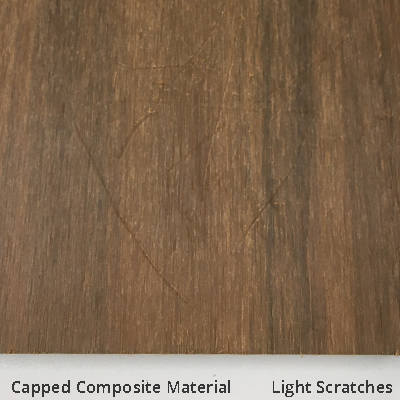
Scratches are simple mechanical abrasion — dragging furniture, pet claws, stiletto heels or grit trapped under shoes displaces material from the surface. Repairability depends on construction: uncapped boards are a single homogenous material, so shallow scratches can sometimes be reduced by light sanding along the grain; capped boards have a thin protective cap over a different-coloured core, so sanding through the cap exposes that core and should generally be avoided.
How to identify it:
Fine linear marks in the direction of foot traffic or furniture movement; deeper gouges may show a different-coloured layer beneath a capped board’s surface.
How to fix or prevent it:
Light surface scratches on uncapped boards: clean, then gently sand along the grain with fine-grit paper.
Capped boards: avoid sanding; light marks can sometimes be reduced with manufacturer-approved products, but deep scratches through the cap usually require replacing the affected board.
Prevention: furniture pads or glides, doormats at entry points, plastic (not metal) snow shovels, and lifting rather than dragging heavy items.
Why Do Composite Decking Boards Come Loose?
The cause:
Boards are held down either by hidden clips in a groove along the board edge, or by face-fixed screws — both engineered to allow thermal expansion while still holding the board in place. Boards work loose when clips are the wrong type for the profile, fasteners are over-tightened (restricting movement so the board eventually cracks around the fixing) or under-tightened, spacing is too wide, or the subframe beneath has moved or begun to decay.
How to identify it:
Boards that flex, rock or click underfoot, or visible gaps where a clip has popped out of its groove.
How to fix or prevent it:
Re-seat or replace clips with the manufacturer-specified type and spacing — don’t substitute generic decking clips across different board profiles.
Check fastener torque; snug, not crushing, is correct for composite material.
Inspect the joist directly beneath a persistently loose board — if the timber has softened or shifted, the fastening problem is a symptom, not the cause.
Why Does the Subframe Under Composite Decking Rot?
The cause:
Composite boards resist rot, but most UK decks still sit on a timber joist subframe, and timber decays where moisture is trapped against it — at cut ends of pressure-treated joists (the preservative only penetrates the surface, so a cut end is unprotected), at the ledger board where the deck meets the house, and anywhere water collects between the decking underside and the joist top.
How to identify it:
Soft, spongy or discoloured joists, movement in boards that isn’t explained by clips or expansion gaps, or a musty smell from beneath the deck.
How to fix or prevent it:
The most robust solution is to use a recycled plastic or aluminium based subframe in persistently damp or ground-contact situations as the material is impervious to rot.
Use a self-adhesive joist tape (a butyl-based flashing membrane) along the top of each joist before boards go down — it seals around fasteners and stops standing water reaching the timber.
Seal or treat cut ends of pressure-treated joists.
Ensure adequate ventilation and clearance beneath the deck so the subframe can dry out between rain events.
Why Does Composite Decking Get Slippery, and Why Does Water Pool on It?
The cause:
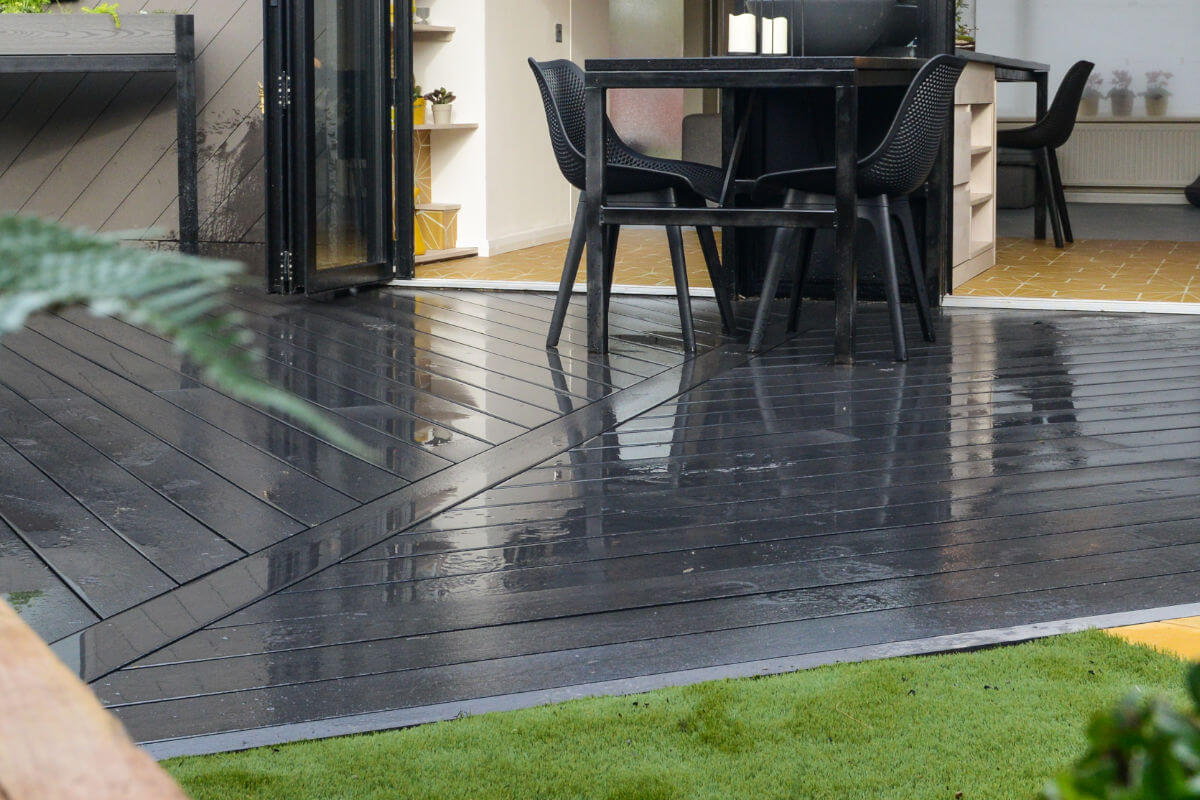
Two related issues. Slipperiness usually comes from a thin biofilm of algae, pollen or organic grime on the board surface — the same growth discussed above — which reduces grip when wet, particularly in the UK’s damp, low-sun climate. Water pooling is a drainage fault: composite boards don’t absorb standing water the way timber does, so if the deck wasn’t laid with sufficient fall, water sits on the surface rather than running off, keeping it wet longer and feeding the biofilm that causes slipping, staining and, in frost, ice.
How to identify it:
Slipperiness: a noticeably slick feel underfoot when wet, worst in shaded areas. Pooling: visible puddling after rain that doesn’t drain within a reasonable time.
How to fix or prevent it:
Slip resistance in the UK is assessed using the pendulum test to BS 7976, producing a Pendulum Test Value (PTV); textured or grooved board profiles are designed to maintain higher PTVs when wet than smooth boards.
Regular cleaning to remove biofilm restores grip on existing decking.
For pooling, decks should be installed with a fall of roughly 1:80 (about 1 cm drop per 80cm) directing water toward an edge or drainage gap, not a flat or reverse-sloped subframe.
Avoid enclosing a deck on all sides without drainage or airflow.
See our full breakdown of whether composite decking is slippery when wet for independent test results by range.
Summary Table: Composite Decking Problems, Causes and Fixes
Problem
Likely cause
Fix
Prevention
Fading
Tannin wash out or UV photo-oxidation of pigments
Accept; not reversible
UV-stabilised capped board
Mould/algae
Debris in surface moisture, shade
Brush + warm water/detergent
Airflow, light, seasonal clean
Gapping/buckling
Thermal expansion without proper gaps
Correct spacing at re-install
Manufacturer spacers/fixings
Staining
Tannins, iron oxide or oils bonding to surface
Oxalic cleaner; degreaser
Prompt cleaning; furniture pads
Scratches
Mechanical abrasion
Sand (uncapped only) or replace
Furniture pads, doormats
Loose boards
Wrong/mis-tightened clips, subframe movement
Re-seat clips; check torque
Board-specific fixing system
Subframe rot
Moisture trapped against joists
Replace/treat joist sections
Non rot substructure, ventilation
Slipperiness/pooling
Biofilm; inadequate fall
Clean surface; correct fall
1:80 fall, textured boards

Frequently Asked Questions
Does mould grow inside composite decking, or just on top of it?
Just on top. Mould and algae feed on trapped moisture, pollen and debris on the surface — they don’t grow within the composite itself.
How much gap should I leave between composite deck boards?
Follow the manufacturer’s spacing guidance for the specific board profile, since gap size depends on board width and expected temperature range; set gaps with spacers, not by eye.
Can you sand out a scratch in composite decking?
Sometimes, on uncapped boards, with fine-grit sanding along the grain. Avoid sanding capped boards — it can cut through the protective cap and expose the different-coloured core beneath.
Why does my deck have gaps of different widths?
Usually inconsistent spacers at installation, or fasteners restricting thermal movement in some sections but not others — an installation issue, not a cleaning or weather problem.
Is composite decking slippery when wet?
It can be, mainly due to a biofilm of algae or grime rather than the material itself. Textured profiles and regular cleaning improve wet-weather grip; UK slip performance is measured using the pendulum test (BS 7976).
Does composite decking rot?
The boards themselves resist rot far better than timber, but most installations still use a timber joist subframe, which can rot if moisture is trapped against it — protecting it with joist tape and ventilation matters as much as the decking choice.
Is Composite Decking Bad for the Environment? The answer depends on the materials, manufacturing process, installation cleanliness and longevity. Composite decking from EnviroBuild has the following attributes to reduce the environmental impact and has been measured to have a considerably lower carbon footprint than timber decking over its lifetime:
Over 90% of the material in our boards is recycled
We use FSC® 100% certified wood
Our manufacturing is powered by 100% renewable wind energy
We are a certified carbon-neutral company
The boards come with long product warranties up to 25 years
Further Reading
Further Reading on EnviroBuild:
External sources: