
Composite Decking Calculator
A composite decking calculator works out exactly how many boards, joists, clips and screws a deck needs from its length and width, then converts that into a total material cost. Enter your dimensions below, or use the manual method in the next section to calculate it yourself.
Get expert decking advice for your project, call us on: 020 8088 4888.
How to calculate how many decking boards you need
Step 1 — Measure your deck in metres
Measure the length and width of the area you're decking, in metres, to two decimal places.
Step 2 — Work out boards needed across the width
Divide the width by the board width plus its side gap, then round up.
Explorer (145mm wide): width (m) ÷ 0.150m
Frontier (143mm wide): width (m) ÷ 0.148m
Example: a 3m-wide deck in Explorer needs 3 ÷ 0.150 = 20 boards across.
Step 3 — Work out board runs needed across the length
Both ranges come in 4m lengths.
Divide your deck's length by 4m and round up; for runs longer than 4m, boards are butt-jointed with a minimum 8mm gap (or 2% of the board's length, whichever is larger) between ends, staggered row to row.
Step 4 — Add wastage
Add 5% to your total board count for a standard square/rectangular layout, or 15% if laying the boards diagonally, to cover cutting waste and mistakes.
Step 5 — Work out joist spacing
Explorer: joists at a maximum of 300mm centres (250mm if laying diagonally)
Frontier: joists at a maximum of 400mm centres (300mm if laying diagonally)
Number of joists needed = (span in mm ÷ centre spacing) + 1, rounded up.
Step 6 — Size the subframe (bearers)
If using plastic lumber or aluminium bearers, match the profile to the support span required:
Bearer Profile
Material Type
Maximum Support Span
50 x 50mm
Plastic Lumber
500mm
50 x 100mm
Plastic Lumber
750mm
50 x 150mm
Plastic Lumber
1500mm
20 x 50mm
Aluminium
500mm
40 x 50mm
Aluminium
1000mm
80 x 50mm
Aluminium
1400mm
Each bearer must be supported in at least 3 places, and shouldn't overhang its last support by more than 50mm.
Step 7 — Count fixings
Allow for a starter clip roughly every 300mm along each joist, plus one hidden fastener per joist at every board (with extra fasteners at board ends).
Step 8 — Get an instant total
Enter the same dimensions into the calculator above to get an itemised list of boards, joists, clips and fixings in seconds.
Reference Table: Board Specifications
Range
Length
Width
Depth
Core
Joists (standard)
Joists (diagonal)
Weight / board
Explorer
4m
145mm
21mm
Hollow, uncapped
300mm
250mm
11.20kg
Frontier
4m
143mm
22mm
Solid, capped
400mm
300mm
13.44kg
Reference Table: Gaps & Clearances
Location
Minimum gap
Between board sides (set by hidden clips)
3-6mm
Board end butt joints
8mm, or 2% of board length if greater
Boards to walls or fixed objects
20mm
Decking overhang past joist
Max. 20mm
Ground clearance over soft ground
Min. 300mm
Drainage fall
0.5% (5mm per metre)
Decking Calculator FAQs
Divide your deck's width by the board width plus its side gap (0.150m for Explorer, 0.148m for Frontier) to get boards per row, then divide the length by the 4m board length for the number of rows. Add 5% for wastage (15% if laying diagonally). Our calculator above does this instantly for any size deck.
Hidden fastener clips automatically set a 3–6mm gap between board sides. Butt joints at board ends need at least 8mm (or 2% of the board's length). Leave a minimum 20mm gap between the decking and any wall or fixed object.
You can use timber, plastic lumber or aluminium joists. If using plastic lumber or aluminium bearers, match the profile to the span: 50×50mm bearers span up to 500mm, 50×100mm up to 750mm, and 50×150mm up to 1,500mm. Each bearer needs support in at least 3 places.
Allow for a starter clip roughly every 300mm along each joist, plus one hidden fastener per joist at every board crossing, with extra fasteners at board ends. So for a single 4m board this equates to ~14 fasteners.
Reduce your joist centres to 250mm (Explorer) or 300mm (Frontier), and increase your wastage allowance from 5% to 15% to account for the extra angled cuts.
In most cases, no, but this depends on the height and total garden coverage of the structure, and whether the property is listed or in a conservation area. Check with your local planning authority before starting work if you're unsure.
Allowing for the expansion gap, one 4m Explorer board covers roughly 0.6m² and one 4m Frontier board covers roughly 0.59m², measured along its length including the gap to the next board.
Explorer decking needs joists at a maximum of 300mm centres (250mm laid diagonally). Frontier decking needs a maximum of 400mm centres (300mm laid diagonally), because its solid core supports a wider span.
Add 5% to your calculated board count for a standard layout, or 15% if you're laying the boards diagonally, to cover cutting waste, mistakes and pattern-matching.
Explorer is a hollow-core, uncapped board (145mm wide, 300mm joist centres, 15-year warranty). Frontier is a solid-core, capped board (143mm wide, 400mm joist centres, 25-year fade and stain warranty). Frontier's solid core allows wider joist spacing, so it typically needs fewer joists for the same deck.
Leave a minimum of 300mm clearance between the underside of the decking and the ground where it sits over soft ground or 50mm when over hard ground, and build in a drainage fall of 1:80 (12.5mm per metre) to stop water pooling under the deck.
This calculator is built specifically around EnviroBuild's Explorer and Frontier composite ranges and their exact board and joist specifications, so results won't be accurate for timber decking, which has different board sizes and span tables.
Ready to Transform Your Outdoor Space?
Take the next step with EnviroBuild composite decking. Whether you're ready to buy or just exploring, our team is here to help you build a garden deck that lasts.
Contact Us
Our team of experts is here to answer your questions.
Send Message
Order Free Samples
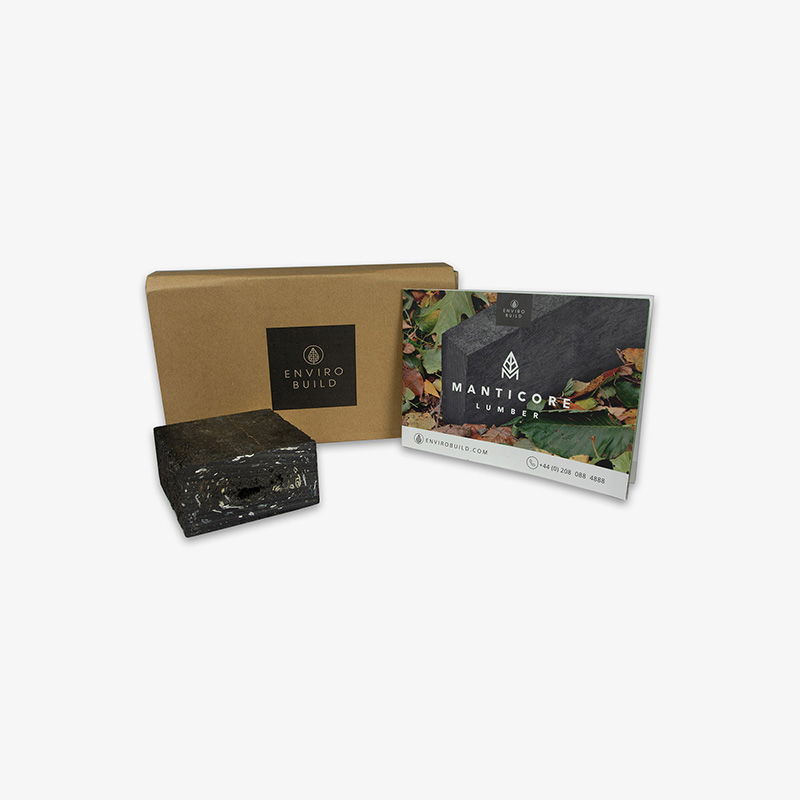
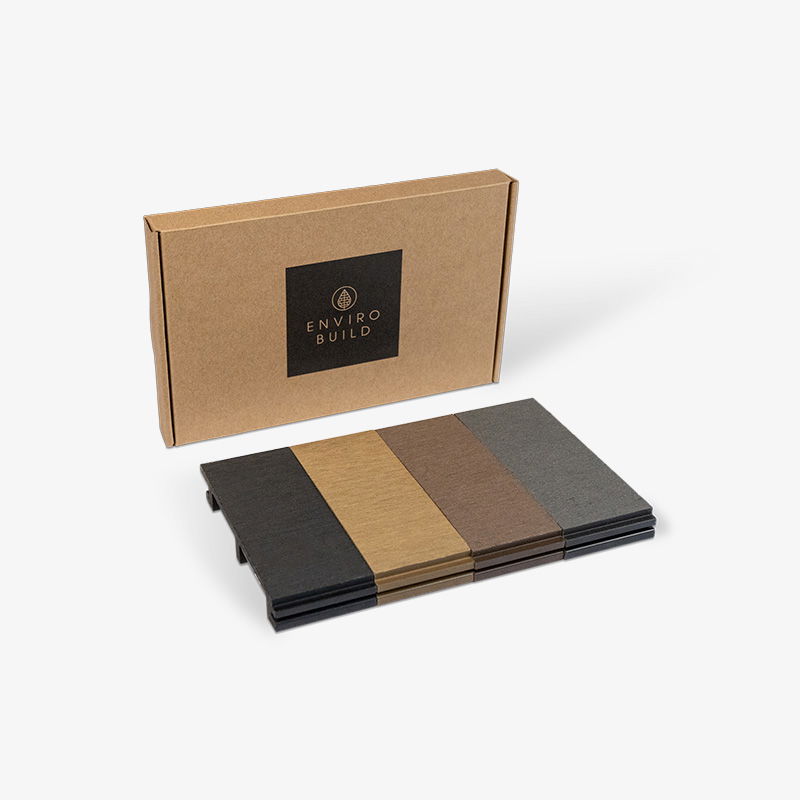
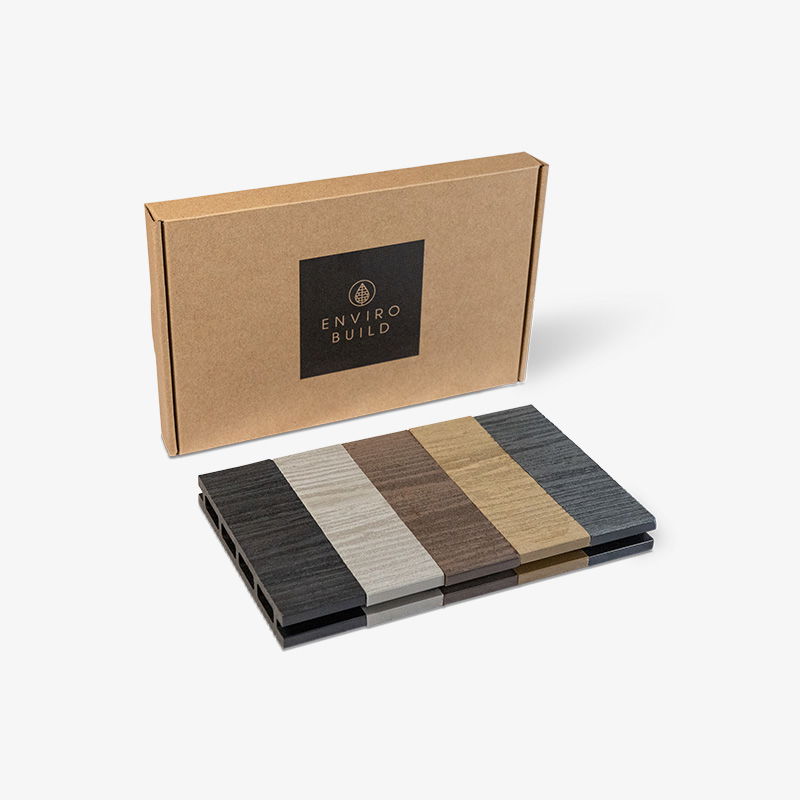
Feel the quality and see the colours before you buy.
Get Samples
Decking Calculator
Estimate exactly how many boards your project needs.
Calculate Now
Request a Quote
Get a tailored price for your complete decking project.
Get Quote

All wood materials we use are FSC® certified

Member of World Land Trust's Carbon Balanced Programme

We donate 10% of our profits to Rainforest Trust UK